
Where Scott County Releases Go
A person can leave the Scott County Law Enforcement Center in several legally different ways. Bond, personal recognizance, dismissal, time served, or completion of a county sentence may return the person to the community. A court order usually explains that result. The final jail entry should show when local custody ended and the disposition recorded by staff.
Another agency may take custody instead. A move to the Kansas Department of Corrections, another county jail, federal authorities, or immigration authorities is a transfer, not a community release. Ask the jail to identify the receiving agency. Then use that agency’s system. KASPER covers KDOC custody and supervision, while the BOP Inmate Locator covers federal Bureau of Prisons records. The ICE detainee locator is limited to locatable immigration detention.
| Outcome | Best confirmation |
|---|---|
| Community release | Final jail entry and court disposition |
| Transfer to KDOC | Jail transfer entry, then KASPER |
| Transfer to another jail | Sending and receiving facilities |
| Federal or ICE transfer | Jail entry and the agency-specific locator |
Confirm Scott County Jail Release
No official Scott County web roster, release archive, mobile app, or booking feed was found in the county’s published pages. Verification is therefore phone-first and record-based. Start with enough detail to separate people who share a name. A booking date or court case number is more useful than a broad request.
- Call the Law Enforcement Center at 620-872-2133 with the person’s name and, if known, booking date.
- Ask whether custody ended through community release or transfer. Request the date, time, disposition, and receiving agency shown in the final entry.
- Check VINELink for the reported county-jail custody change. Kansas VINE does not cover KDOC prisons.
- Use the Kansas District Court Public Access Portal or the Scott County court file to identify the bond, dismissal, sentence, or other order.
- If the entry names another agency, continue in that agency’s locator and do not describe the transfer as freedom.
The Scott County released-inmate search and records path brings these channels together. A court order and physical release can have different timestamps because jail staff still must process the order. Keep both times when reconstructing the event.
Scott County LEC Records Contact
The county identifies Roni Heili as the jail contact during posted weekday hours. The central number also serves the joint law-enforcement environment. Law enforcement and emergency services operate around the clock, but that does not mean detailed records work follows the same schedule.
Scott County Law Enforcement Center602 West 5th Street
Scott City, KS 67871
Phone: 620-872-2133
Fax: 620-872-3264
Jail contact hours: Monday–Friday, 8 a.m.–5 p.m.
For a written record, describe an existing booking or release document rather than asking the Sheriff to create a new report. Useful requested fields include the full name used at booking, booking number, admission date and time, release date and time, release reason, releasing authority, bond status, court case number, destination, transfer agency, and whether a booking image is releasable. Kansas Open Records Act fees may reflect reasonable actual cost and may be required in advance. No Scott-specific sheriff fee schedule or online request form was verified.
Request Scott County Release Records
A written request is useful when a phone answer does not supply the exact disposition or when a copy is needed. Address the request to the Scott County Sheriff’s Office or Law Enforcement Center at the facility address. Identify one custody episode with the person’s booking name and an approximate arrest or booking date. Ask for existing records. Kansas law does not require the Sheriff to create a custom release list, answer research questions, or calculate facts that are not already recorded.
Request the booking number, booking date and time, release date and time, recorded release reason, and destination or receiving agency if the event was a transfer. A booking photograph should be requested separately because its disclosure can require a different review. Charges shown at booking are allegations unless resolved by a court. If part of a record is withheld, ask for the statutory basis and for any nonexempt portion that can reasonably be separated from protected material.
The Kansas Open Records Act allows reasonable actual-cost fees and advance payment. Its three-business-day rule requires the agency to provide access, furnish copies, or explain a delay and state when the record is expected. It does not promise that every request will be fully produced within three days. No Sheriff-specific Scott County fee schedule was found, so the court’s separate per-page copy price must not be applied to jail records. A narrow date range and field list can reduce staff time and cost.
Inside Scott County’s Shared LEC
The official Law Enforcement page describes a joint building used by the Scott County Sheriff’s Office and Scott City Police Department. Dispatch also operates there. The county says its jail has room for 24 people. That figure describes capacity, not average custody, annual bookings, or the number released.
The county’s official facility description and jail contact appear in the image below.
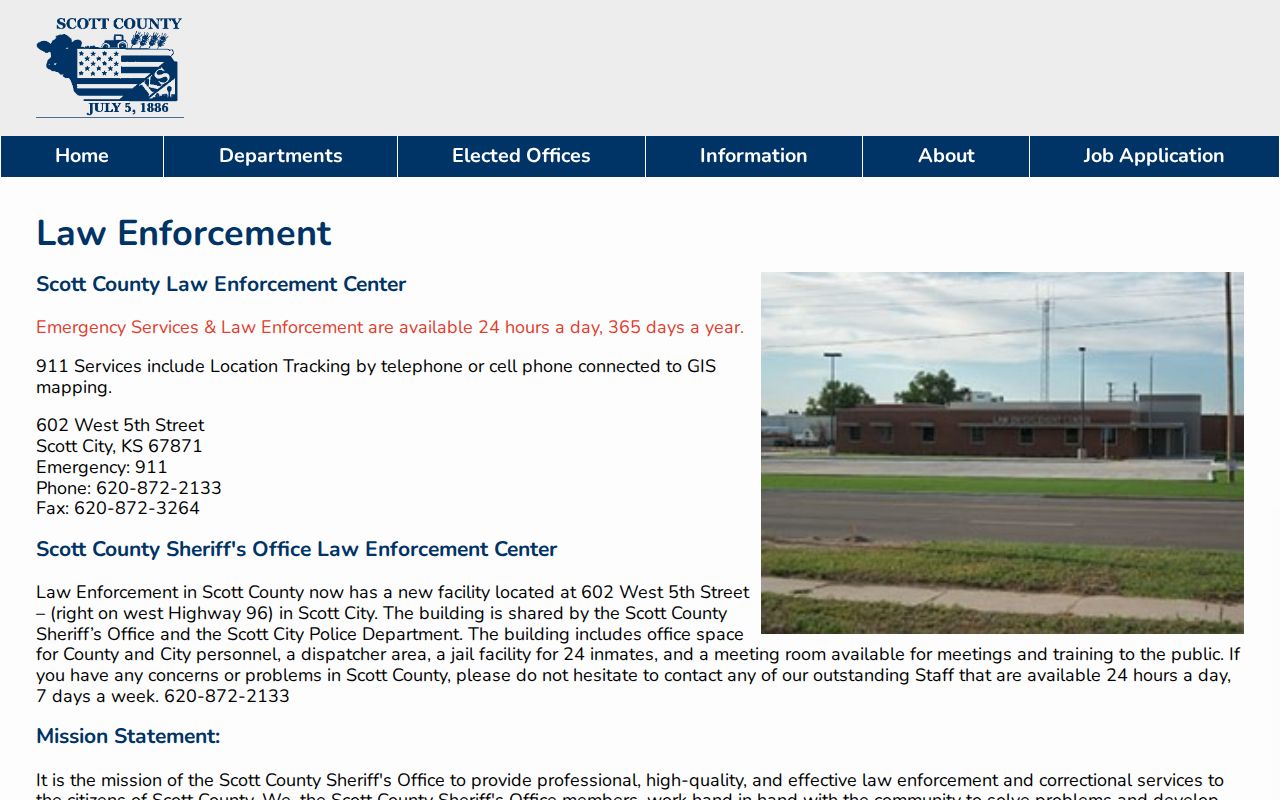
The source confirms the shared local center and contact route, while the final booking entry is still needed to determine whether a named person was released or transferred.
Scott City Police temporary custody does not create a separately documented municipal jail. The arresting agency may be police while the custody record sits with the shared center. Municipal and state criminal matters can also proceed in different courts. Ask which agency holds the booking record and which court received the charge before requesting documents.
Scott County’s Small Shared Jail
The local jail’s scale shapes release access. One official number reaches the joint Sheriff, police, dispatch, and jail setting. There is no separate public portal to preserve past custody. A direct call can therefore answer the first question quickly, but a written record remains the stronger choice when the exact disposition matters.
The county calls the center a new facility but gives no opening year. Its official facts support only the shared-building arrangement and 24-person capacity. They do not support claims about construction history, typical occupancy, release volume, or average stay. Those details should not be inferred from the building’s size.
Phone-First Scott County Verification
The official 620-872-2133 line is available through the law-enforcement setting at all hours. Detailed jail inquiries have separate weekday contact hours. Ask a narrow question: “Did this booking end in release to the community or transfer to another agency?” That wording prevents a simple “not here” answer from being mistaken for release.
Pam McDaniel is named as Scott County’s Local Freedom Information Officer at 620-872-2420. Her county page can help with open-record navigation, but its affirmative disclosure details concern Register of Deeds records. It should not be treated as a Sheriff records policy, fee schedule, or promise that a jail record will be released.
Scott County Court Release Proof
The court record often supplies the legal reason custody ended. Scott County District Court is at 303 Court Street, second floor, in Scott City. Its posted hours are Monday through Friday, 8 a.m. to noon and 1 p.m. to 5 p.m. Official county and judicial-district pages list phone numbers that differ by one digit, 620-260-2553 and 620-260-2552, so verify before relying on either.
The Scott court procedures provide public computers in the clerk’s office, require visitors to sign in, and list copies at $0.25. That court copy price does not apply to Sheriff records. The statewide portal may show case information without every document image. A sealed or expunged matter may also be unavailable to the public.
Missing Scott County Release Details
No official source supplied a standard release hour, weekend rule, public exit, waiting area, transport option, property-return process, bond schedule, or booking-photo policy. Family and friends should not assume a time or door. Confirm logistics with jail staff for the individual event.
A release record can also be restricted. Juvenile material, sealed matters, and expunged arrest or conviction records may not remain publicly available. An agency can redact exempt content while releasing a nonexempt part. If access is denied, ask for the legal basis and the name of the record custodian who made the decision.
After any community release, supervision is a separate question. KASPER may show KDOC parole or community-corrections status, while the 25th Judicial District handles local court services and community corrections. A completed jail stay does not itself prove that supervision ended.
Public Record Search
Sponsored Results