
Scott County Projected Versus Actual Release
A projected date is a calculation, not proof that someone walked out. It estimates a custody endpoint under the sentence, credit, and legal facts then in force. An actual release is a recorded movement. Even an actual departure from the Scott County Law Enforcement Center may be a transfer to KDOC, another jail, federal authorities, or another agency rather than release into the community.
Pretrial custody works differently. A person held before judgment has no sentence endpoint to calculate. Bond, recognizance, dismissal, a court release order, or another hold can determine when custody changes. For a county sentence, the judgment and the jail’s own calculation must be paired. For a KDOC sentence, read KASPER and obtain KDOC computation information when greater detail is needed.
| Date or event | Meaning | Best confirmation |
|---|---|---|
| Bond eligibility | A path to pretrial release, not a release time | Court order and jail event |
| Parole eligibility | The Board may consider release | Board process and later KASPER status |
| Computed sentence date | An agency calculation subject to later change | Jail or KDOC sentence record |
| Actual movement | Custody changed on the recorded date | Final jail or KDOC movement |
| Discharge | The shown agency’s authority ended | Final agency status or court order |
Find Scott County Inmate Release Dates
Start with the holding authority. The arrest county does not tell where a sentenced person is now, and absence from the local jail does not identify what happened next. Use the person’s full name, identifying number when known, court case, and approximate custody dates to avoid mixing records.
- Call the Scott County Law Enforcement Center at 620-872-2133 to ask whether the person is currently held and whether the latest event was release or transfer.
- Search the Kansas District Court Public Access Portal and narrow to Scott County. Read the bond, judgment, sentencing, modification, probation, and warrant entries.
- For a county sentence, obtain the sentencing journal entry and ask the jail for its computed release entry, including applied jail credit.
- For a KDOC sentence, enter through KASPER, match the correct identity, and read the exact status, movement, sentence, and date labels displayed.
- Decide whether a date means eligibility, a calculated endpoint, a maximum term, or an actual movement. Never rename one category as another.
- Confirm release through the final jail or KDOC movement. Kansas VINE is for county-jail custody, not a KDOC prison date.
The official KASPER entry and disclaimer are shown below.
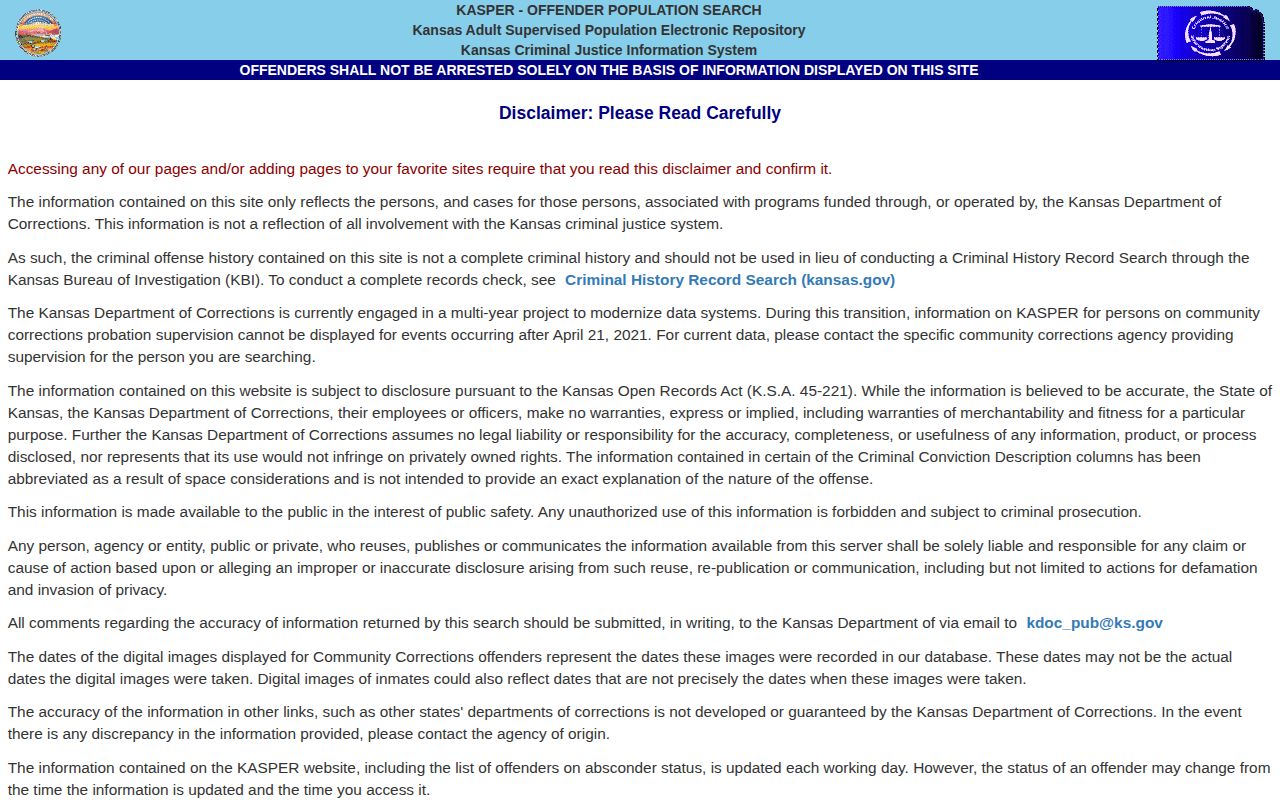
The disclaimer is part of the lookup. KASPER updates each working day, is not a complete criminal history, and should be checked against the individual sentence and movement record.
Scott County KASPER Date Labels
KASPER is the official Kansas Adult Supervised Population Electronic Repository. Its search supports name, alias, KDOC number, State ID or KBI number, birth date, age range, race, gender, conviction county, parole supervision county, community-corrections location, facility, photograph display, and supervision type. Status choices include Inmate, Parole, Community Corr., Absconder, Discharged, Discharged-Deceased, Deceased, Unknown, and All.
Those search controls help locate the correct state record, but they do not establish the exact label used for every future date on an individual results page. The research could not lawfully verify that detail behind the CAPTCHA without opening a real person’s result. Therefore, use the label that appears on the live record. Do not substitute “tentative,” “conditional,” “maximum,” “projected,” or “parole eligible” as though those terms were equal.
“Parole” means the person left prison under continuing KDOC supervision. “Discharged” is the most useful KASPER filter for completed KDOC authority, though the movement and sentence record still deserve review. A Scott County jail detainee will not appear merely because the arrest happened locally. KASPER applies only if the person entered KDOC custody or supervision.
| KASPER status | Practical reading |
|---|---|
| Inmate | State prison custody shown |
| Parole | Community release with supervision continuing |
| Community Corr. | Community-corrections supervision shown |
| Absconder | Required supervision contact is reported lost; warrant status needs separate confirmation |
| Discharged | KDOC authority is shown as completed |
| Unknown or All | Broader search categories, not proof of a specific result |
Kansas Good Time for Scott Cases
K.S.A. 21-6821 authorizes Kansas good-time rules. For crimes committed on or after July 1, 1993, it generally caps credit at 15 percent of the prison portion. Certain nondrug severity-level 7 through 10 offenses committed on or after January 1, 2008, and specified drug categories and offense dates may qualify for a 20 percent cap. Eligible lower-severity sentences may also receive program credits under statutory and regulatory conditions.
The common “85 percent rule” is shorthand for the ordinary 15 percent maximum credit against the prison portion. It is not a universal formula for every Kansas sentence. Some eligible categories can reach 20 percent. Older indeterminate sentences, off-grid or life cases, consecutive terms, jail credit, sentence changes, and other rules follow different paths. Credits may be withheld or forfeited. For some qualifying sexual offenses, earned time can be added to postrelease supervision rather than ending all supervision sooner.
Good time changes a calculation only when the governing law and record make it available. It should not be applied by taking 15 percent off a raw sentence at home. KDOC calculates its state sentences. Scott County has published no local good-time worksheet, county earned-time policy, or computation guide. State-prison percentages must not be copied onto a county-jail term.
K.S.A. 22-3717 governs parole eligibility and postrelease or conditional-release structures. Eligibility lets the Board consider a qualifying person. It does not compel a release on that date.
Why Scott County Release Dates Change
A date changes when the facts used in the calculation change. Some changes affect the sentence endpoint. Others do not change the sentence itself but keep the person in custody under another legal authority. Read the later movement and destination rather than assuming every delay is discipline or every early movement is community release.
| Factor | Possible effect | Record to check |
|---|---|---|
| Credit award or forfeiture | Moves the computed KDOC date within governing rules | KDOC computation and disciplinary record |
| Jail credit correction | Changes time credited before sentencing | Judgment and agency calculation |
| Sentence modification or appeal | Changes the term or legal basis | Later court order |
| Consecutive sentence | Extends the combined custody period | Sentencing records and computation |
| Detainer or hold | Another agency may assume custody | Jail disposition and receiving agency |
| Parole decision | May permit supervised release or postpone review | Board record and later KASPER movement |
| Administrative recalculation | Corrects the projected endpoint | Current KDOC record |
- Good time
- Credit authorized by law and corrections rules that can reduce the prison portion.
- Detainer
- A notice that another authority may seek custody when the current hold ends.
- Parole
- Discretionary release from prison under continuing supervision.
- Postrelease supervision
- A required supervision term after the prison portion of many determinate sentences.
- Discharge
- The end of the authority reflected by the controlling agency record.
Scott County Jail Date Calculation
Scott County publishes no county-jail projected-date calculator, good-time worksheet, weekend-release rule, or jail-credit computation practice. That gap defines the correct local method. A pretrial detainee’s departure turns on bond or a court order. A county-sentenced person’s date comes from the judgment, credited time, and the jail’s actual computation. A KDOC prisoner uses the separate state framework under K.S.A. 21-6821 and the individual KDOC record.
Do not assume a Sunday endpoint moves to Friday, that releases occur at a fixed hour, or that every county sentence earns the state-prison percentage. No official Scott source supports those claims. Call the LEC during the detailed jail contact’s posted weekday hours when possible, though the shared dispatch number is staffed for law-enforcement access around the clock. Ask for the computed entry and final disposition rather than asking staff to estimate from the sentence.
The Scott District Court judgment can show the sentence and jail credit, while the jail record supplies the administrative release event. These sources answer different parts of the question. An order can precede physical processing. Record both the court time and the actual jail departure time when precision matters.
Scott County Parole Eligibility Dates
The Kansas Prisoner Review Board publishes monthly public-comment sessions and lists for people nearing parole-eligibility hearings. A list may show a Scott County conviction even while the person is housed elsewhere. The sequence is hearing eligibility, Board action, and a possible later release. Presence on a monthly list is not a favorable decision, and disappearance from a later list is not proof of release.
For older indeterminate sentences, the Board may parole, pass, or continue. A pass denies release and sets a later review period. A continue delays action for more information or deliberation. Many post-1993 determinate grid sentences use postrelease supervision rather than discretionary parole. Sentence law, not a generic date calculator, decides which structure applies.
Use the public-comment schedule to understand timing and the Board process to interpret outcomes. Then confirm the actual movement in KASPER or through KDOC. The Scott County jail cannot verify a later parole from a state institution.
Confirm Scott County Actual Release
For a county-jail event, Kansas VINE can report a custody change and send an alert if registration occurred while the person was held. It does not cover KDOC prisons. The VINELink Release Check explains how to match a Scott County record and register. A VINE notice should still be paired with the LEC release disposition because a transfer is not community release.
For state prison, read the latest KASPER status and movement. For a Scott court case, retrieve the actual bond, dismissal, judgment, sentence, or later discharge order. If a written local record is needed, request the final booking event, release date and time, disposition, destination, and receiving agency. The broader Scott County released inmate search joins these records when the custody trail crosses agencies.
Federal systems remain separate. The BOP locator supplies federal custody and release information. ICE uses its detainee locator. U.S. Marshals custody has no general public name locator, so the federal docket and agency verification matter. A date from one system never proves that every other hold or supervision term ended.
Public Record Search
Sponsored Results