
Scott County 24-Hour List Status
A review dated July 18, 2026 found no official Scott County web roster, recent-release archive, sheriff app, or page limited to one day. The county’s official sitemap and targeted searches of its law-enforcement material exposed only facility and contact pages. Results for release feeds in other states belong to other counties named Scott and cannot be used as Kansas records.
A “released last 24 hours” label therefore describes the search period. It does not name a government data product. The Scott County Law Enforcement Center page is the official starting point. Its central number is 620-872-2133. Ask whether the person remains in local custody and whether the final event was a community release or a transfer.
Check Scott County Same-Day Releases
Start with one named person and one known custody episode. A broad list request can fail because Kansas public-records law does not require an agency to create a new report that it does not maintain. A narrow inquiry also makes it easier for jail staff to separate a release from a move to another agency.
- Call the Scott County Law Enforcement Center. Give the full name and, if known, birth date, arrest date, or booking number. Ask whether the person is still held.
- If not held, ask whether the last event was release into the community or transfer. Request the date, time, disposition, and receiving agency shown in the final custody event.
- Check VINELink for a reported Kansas county-jail status change. Match the identity and facility before relying on a result.
- Search the Kansas District Court Public Access Portal and narrow the case to Scott County. Look for a bond, dismissal, release, judgment, or sentencing entry.
- If a written result is needed, send a focused Kansas Open Records Act request for the existing booking or release entry rather than asking the sheriff to compile a new daily list.
For a wider date range, use Released Last 72 Hours. A search for one person’s older release can also begin on the home page.
Kansas VINE works best as a forward-looking tool. Registration is tied to a specific person while that person is in an adult county jail. A later release notice can help place the event in the same-day timeline, but the reviewed state material does not promise an indefinite history after release. If no match appears, check spelling, identifiers, and jurisdiction before drawing a conclusion. A short booking, a system delay, or custody outside an adult Kansas county jail can all produce a missing result.
The safest same-day note records four things: who supplied the information, when it was checked, which custody system was involved, and the exact words used for the outcome. “Not currently held” is not the same as “released to the community.” Ask one more question when the answer is vague. If the jail identifies another custodian, switch to that agency’s system instead of repeating the county search.
Scott County Release Fields to Request
Scott County has not published a feed schema, so the entries below are a request checklist. They are not a promise that each field exists or is open. Asking for the final event and its destination prevents a bare “not here” response from being mistaken for proof of community release.
| Requested field | Why it matters |
|---|---|
| Committed name and booking number | Links the answer to the correct person and custody episode. |
| Booking and release date/time | Shows whether the final event falls within the one-day window. |
| Release disposition | Separates bond, recognizance, dismissal, time served, sentence completion, and court-ordered release. |
| Destination or receiving agency | Shows whether the person entered the community or moved to another custodian. |
| Hold or detainer | May explain why one agency’s custody ended while another began. |
A detainer is a request by another authority to hold or transfer a person. It can change the practical result even after the Scott County matter allows release. The court order and jail entry should therefore be read together.
Charges listed at booking are allegations until the court resolves them. If the request includes charges, bond, or the arresting agency, keep those facts tied to the exact booking number and date. Similar names can otherwise merge separate cases. A property receipt or release acknowledgment may also document the administrative process if the jail maintains it and the record is open, but Scott County has not published a policy promising either document.
Why Scott County Uses Fallbacks
Scott County’s lack of a public roster is the key local fact, not a missing detail to conceal. The official county sources do not supply a one-day archive, update schedule, retention term, field list, or photo policy. Kansas VINE provides the only identified public electronic layer for adult county-jail custody changes, but it is a person-specific alert and status service. It is not a sheriff-maintained history of everyone released today.
Direct LEC confirmation answers the physical-custody question. The Scott District Court file can explain the legal cause. A narrow records request can preserve the jail event in writing. Together, those channels rebuild a defensible same-day timeline without claiming that Scott County publishes a product it does not have.
The source image below shows the official county facility page used for the local contact route. Open the Scott County Law Enforcement page for the current version.
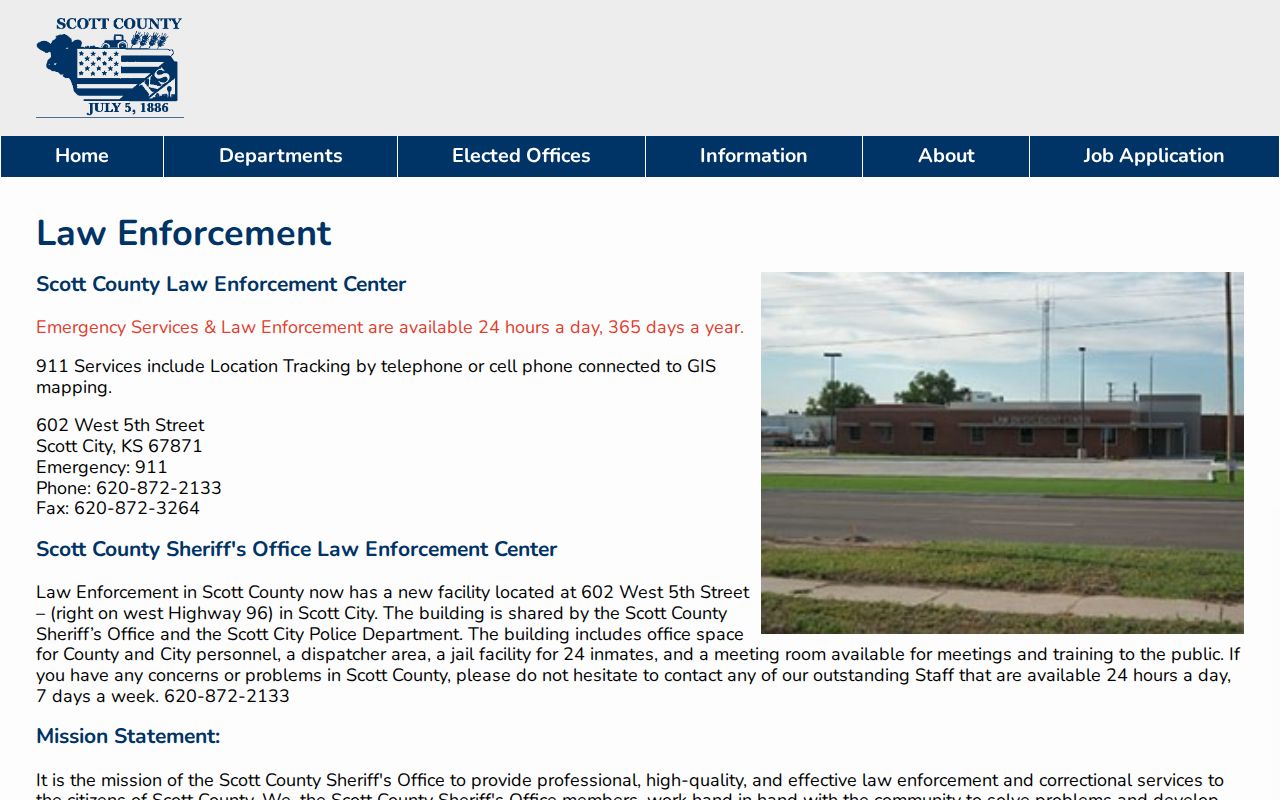
The capture supports the jail and contact facts. It does not display, or imply the existence of, a recent-release feed.
Read Scott County Release Outcomes
Leaving county custody does not always mean going home. Bond, recognizance, dismissal, a court release order, time served, or completion of a county sentence will often lead to community release after processing. A transfer to KDOC, another county jail, federal authorities, or immigration custody also ends Scott County’s physical control, but the person remains held elsewhere.
- Release
- The Scott County jail’s physical custody ends, often with a disposition that explains why.
- Transfer
- Custody passes to another agency. This is not community release.
- Parole
- A person leaves state prison under KDOC supervision.
- Discharge
- The displayed correctional authority has ended, though another case or agency may still matter.
If the jail reports a KDOC transfer, search KASPER. Use its status and movement history for Kansas prison custody. Kansas VINE expressly excludes KDOC prison residents. Federal Bureau of Prisons records and ICE’s locator likewise cover their own systems, not a Scott County jail release.
KASPER distinguishes state statuses that often sound alike. “Parole” means release from confinement with supervision still active. “Discharged” is the more useful filter for completed KDOC authority. Neither label establishes what happened in an unrelated county booking. The repository updates each working day, so a same-day local call may be newer than the state record.
Confirm Scott County Release Orders
The court record can show why the jail acted. Search by party name or case number, select Scott County, and read the actual document when one is available. Useful entries include bond orders, dismissal, judgment, sentence, probation, revocation, and discharge. A court calendar merely shows a scheduled event. It does not prove that someone walked out of the jail.
The Scott court procedures also provide an in-person route through public computers in the clerk’s office. Some online case entries do not include document images, and protected or expunged matters will have access limits. The jail’s final event supplies the physical release time; the court file supplies the legal basis. Keep both timestamps when they differ.
For a written jail record, Kansas law allows reasonable actual-cost fees and advance payment. The county has not posted a sheriff release-record fee schedule, so the court’s separate copy rate must not be applied to sheriff records. State the name, booking range, and exact record sought. If staff time or cost is expected to be high, current law calls for reasonable communication about ways to reduce cost in specified circumstances.
A court case can stay open after bond or recognizance release. Probation and postrelease supervision can also continue after confinement ends. Release records should be used to answer the custody question actually asked, not to infer that all legal duties ended. When an expungement or sealing order limits access, rely on the court’s current treatment of the record rather than old search copies.
Public Record Search
Sponsored Results